Seventh Grade Here I Come SVG: A Practical Asset for Educators, Makers, and Small Business Owners
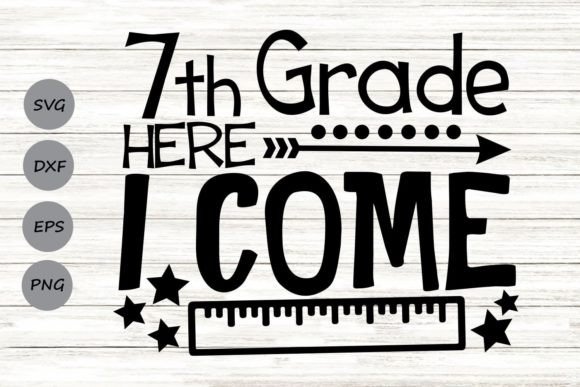
When you’re preparing for the school year—whether you’re a teacher designing classroom decor, a parent crafting personalized first-day-of-school signs, or a small business owner creating custom apparel for back-to-school season—the Seventh Grade Here I Come SVG isn’t just decorative. It’s a tactical resource. Its value lies not in novelty, but in precision: it delivers consistent, scalable, production-ready vector assets across SVG, DXF, PNG, and EPS formats—each tailored for specific tools and workflows.
Why Format Flexibility Matters More Than You Think
Most users download SVG files without considering how format constraints affect execution. The Seventh Grade Here I Come SVG bundle includes four file types—not as redundancy, but as intentional coverage. An SVG file works natively in Cricut Design Space and modern web editors. A DXF file is essential for Silhouette Studio users who need layered vector paths—not raster traces. The PNG version (with transparent background) supports quick mockups in Canva or PowerPoint, especially when using the Standard Edition’s trace function. And the EPS file (v10) ensures compatibility with legacy design software like Adobe Illustrator CS6–CC, where newer SVG interpretations sometimes falter.
This breadth means you avoid last-minute format conversions that degrade quality or introduce alignment errors. For educators printing bulletin board letters, for example, using the SVG directly in Cricut avoids pixelation at large sizes. For a boutique selling “7th Grade” tumblers, the DXF ensures clean cut lines on a Brother ScanNCut—no manual path reconstruction needed.
Strategic Use Cases Beyond Decoration
Think of the Seventh Grade Here I Come SVG not as a one-off graphic, but as a modular communication element. Its utility scales with intention:
- Classroom Onboarding: Teachers use it to label student supply bins, create welcome banners, or embed into digital slide decks—reinforcing identity and transition at a pivotal academic milestone.
- Small Business Positioning: Custom apparel shops apply it to iron-on transfers for hoodies or tote bags targeted at rising 7th graders and their families—a niche with high emotional resonance and predictable annual demand.
- Parent-Led Creativity: Hobbyists combine it with other back-to-school SVGs (e.g., “First Day of School,” “School Supplies”) to build cohesive photo booth kits—turning personal milestones into shareable, branded moments.
- Educational Publishing: Curriculum designers integrate the text-based vector into editable worksheets or interactive PDFs, preserving typographic integrity across devices and print runs.
Each use case relies on the same underlying asset—but success depends on matching format to purpose. Using the PNG for vinyl cutting, for instance, introduces unnecessary rasterization and edge softness. That’s not a file flaw; it’s a misalignment between goal and tool.
Planning Ahead: When and How to Deploy This SVG Intentionally
Timing matters. The Seventh Grade Here I Come SVG has highest leverage when deployed during planning windows—not rush hours. Consider these rhythms:
- Early Summer (June–early July): Ideal for bulk prep—ordering vinyl, pre-cutting stencils, or building product listings. You’ll avoid shipping delays and stock shortages by aligning production with your own capacity, not seasonal spikes.
- Mid-July (Curriculum Planning Cycle): Teachers embedding this into lesson plans or classroom systems gain consistency. It becomes part of a visual language—not an afterthought.
- First Week of August (Marketing Rollout): Small businesses launching back-to-school collections benefit from early asset testing—confirming color accuracy, layer order, and cut settings before scaling.
Before deploying, ask: What outcome am I optimizing for? If it’s speed, prioritize the SVG in Cricut Design Space. If it’s archival fidelity or print production, lean on EPS. If it’s rapid prototyping in non-cutting software, the PNG suffices—provided resolution meets your output standard (300 DPI minimum for print).
Risks of Context-Free Usage
Without clear goals, even high-quality files become liabilities. Common pitfalls include:
- Brand Dilution: Slapping the Seventh Grade Here I Come SVG onto every product without considering audience fit—e.g., using playful fonts and colors for a college-prep tutoring service—undermines credibility.
- Operational Friction: Assuming all formats behave identically across machines. A DXF that cuts cleanly on a Silhouette Cameo may require path simplification for a Cricut Maker due to differing firmware handling of compound paths.
- Missed Differentiation: Relying solely on this phrase without customization—like adding a school mascot, district name, or student’s name—reduces memorability and perceived effort.
These aren’t flaws in the file—they’re signals that execution requires context. The SVG is neutral infrastructure. Your strategy gives it meaning.
Customization That Adds Real Value
The real ROI emerges when you treat the Seventh Grade Here I Come SVG as a starting point—not an endpoint. Simple, low-effort modifications yield outsized impact:
- Add a subtle gradient overlay in your design software to match school colors—no extra licensing, no new file needed.
- Group it with a simple icon (e.g., a pencil, graduation cap, or open book) to reinforce theme without clutter.
- Convert the text to outlines, then adjust letter spacing (kerning) for tighter visual cohesion—especially important for signage viewed at distance.
- Use the EPS version to generate high-res PDFs for printed handouts or digital newsletters—ensuring crisp rendering across devices and email clients.
None of these require advanced skills. They do require pausing to consider where the asset will live and who will interact with it.
Long-Term Value: Beyond the School Year
While tied to a specific grade level, the Seventh Grade Here I Come SVG supports longer-term objectives. For educators, it becomes part of a reusable library—paired with similar assets for 6th or 8th grade to maintain visual continuity across middle school transitions. For entrepreneurs, it’s a template for seasonal iteration: swap “7th” for “8th” next year, update colors, repackage—and retain customer trust through recognizable structure.
Even file organization reflects strategic thinking. Store the ZIP with clear naming: seventh-grade-here-i-come_v1_2024.zip. Include a README noting tested machines, recommended materials (e.g., “Works best with Oracal 651 vinyl at 120g force”), and version history. That discipline pays dividends when onboarding team members or revisiting projects months later.
Ultimately, the Seventh Grade Here I Come SVG succeeds not because it’s clever, but because it removes friction from meaningful work—whether that’s welcoming a nervous student, launching a thoughtful product line, or reinforcing institutional identity. Its power lies in reliability, adaptability, and quiet precision. Use it deliberately, match format to function, and let the clarity of the asset serve your larger goals—not the other way around.