1st Day of School PNG Sublimation Design: A Practical Guide for Creators and Educators
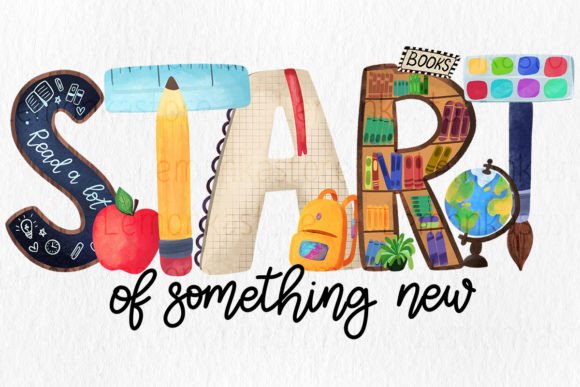
A 1st Day of School PNG Sublimation Design is a ready-to-use digital illustration optimized for heat-transfer printing—specifically sublimation—on polyester-based materials. Unlike standard clipart or generic school-themed graphics, this design features a cohesive composition centered on the phrase “START of something new,” surrounded by stylized school items: a pencil, open book, backpack, apple, and graduation cap. Its defining technical traits include a transparent background, 300 dpi resolution, and vector-aligned raster clarity—making it suitable not only for sublimation but also for sticker production, poster printing, and digital overlays.
What Sets This Design Apart from Other Back-to-School Graphics?
Most back-to-school assets fall into one of three categories: generic SVG bundles (often low-resolution or overused), hand-drawn illustrations (unique but inconsistent in scalability), or text-heavy templates (limited in visual flexibility). The 1st Day of School PNG Sublimation Design bridges several gaps at once. It’s not a layered PSD file requiring editing expertise, nor is it a compressed JPEG with visible artifacts. Instead, it delivers a single, high-fidelity PNG that retains crisp edges even when scaled to fit a tote bag or stretched across a 24” x 36” poster.
The inclusion of school-related icons isn’t decorative filler—it’s intentional visual scaffolding. Each item reinforces the theme without cluttering the message. That balance matters when evaluating alternatives: overly busy designs lose legibility on curved surfaces like water bottles or tumblers, while minimalist text-only options lack the warmth and recognizability parents and students associate with the first day of school.
How It Compares Across Printing and Application Methods
Sublimation printing relies on dye diffusion into polyester fibers, which means image quality hinges on two things: color depth and edge definition. A PNG with transparency and 300 dpi meets both requirements more reliably than an RGB JPEG saved at 72 dpi—or even a well-designed SVG converted poorly to raster format. In practice, users report noticeably richer blacks and smoother gradients with this 1st Day of School PNG Sublimation Design, especially on light-colored apparel and ceramic mugs.
For non-sublimation uses, the same file serves multiple purposes—but with tradeoffs. On vinyl-cut stickers, the transparent background allows clean die-cutting around the outer shape, though fine details (like the spiral binding on the notebook icon) may require minor manual cleanup depending on cutter precision. For screen printing, the design would need conversion to spot-color vector art—a step not required for sublimation, where the full-color raster renders directly.
Compare that to editable Canva templates: they offer customization but often export at lower resolutions unless upgraded to premium plans. Or consider AI-generated school graphics—while fast and free, they frequently produce inconsistent proportions, misaligned text, or unintended symbolism (e.g., apples with stems pointing downward, which some educators note can unintentionally evoke negative connotations). This 1st Day of School PNG Sublimation Design avoids those pitfalls through deliberate, human-led composition.
Real-World Use Cases and Fit Assessment
Teachers organizing classroom welcome kits often use this design on reusable drawstring bags—printed via sublimation on polyester fabric. The durability of the print holds up after repeated washing, unlike iron-on transfers that crack or peel. Similarly, PTAs ordering spirit wear for orientation events find the “START of something new” phrasing resonates across grade levels, avoiding age-specific references (e.g., “Kindergarten Rocks!” or “Senior Year Countdown”) that limit reuse.
Small-batch crafters appreciate how little prep the file requires. No clipping paths to build, no background removal needed, no font licensing concerns—the typography is embedded as pixels, ensuring consistent rendering regardless of local system fonts. That’s a meaningful advantage over editable PSD or AI files, where missing fonts or mismatched layers delay production.
However, this design isn’t ideal for every scenario. If you’re creating bilingual materials (e.g., English/Spanish dual-language classrooms), the fixed text prevents direct translation without redesign. Likewise, institutions needing ADA-compliant large-print versions would need to recreate the layout at larger scale—though the 300 dpi resolution does allow moderate enlargement before pixelation becomes apparent.
Key Decision Factors When Choosing This Design
Consider the 1st Day of School PNG Sublimation Design if your priority is speed-to-production with minimal post-processing. It suits users who already own or rent sublimation equipment, work with polyester substrates, and value thematic cohesion over granular customization. It’s equally practical for educators making small batches (under 50 units) or makers selling seasonal items on platforms like Etsy or Teachers Pay Teachers.
It becomes less optimal if your workflow centers on cotton-based fabrics (where sublimation doesn’t adhere well without polymer coatings), if you require editable layers for brand alignment (e.g., swapping out the apple for a specific mascot), or if your audience expects highly personalized elements—like student names or grade-level icons. In those cases, investing in custom illustration or using scalable vector templates with open-source fonts may yield better long-term flexibility.
Also weigh storage and compatibility. Because it’s delivered as a single PNG, there’s no risk of missing linked assets or corrupted layer groups. But unlike cloud-based design tools, it won’t auto-update if trends shift—say, if “backpack” iconography evolves toward eco-friendly designs or inclusive representations. That’s not a flaw; it’s a reflection of its purpose: a focused, production-ready asset—not a living design system.
Practical Tips for Best Results
- Test print on scrap material first—especially when using new substrates or printers, to verify color fidelity and edge sharpness.
- Use sRGB color profile for consistency across monitors and printers; avoid converting to CMYK unless preparing for offset printing.
- Check substrate polyester content: sublimation works best on ≥65% polyester blends. Cotton-poly blends below that threshold may yield faded or uneven results.
- Store the original file separately from edited versions—this preserves the pristine 300 dpi source for future reprints or scaling.
Ultimately, the 1st Day of School PNG Sublimation Design occupies a distinct niche: it’s neither a DIY toolkit nor a mass-market stock graphic. It’s a precision-crafted starting point—designed for clarity, built for durability, and tested for real-world application. Whether you're equipping a classroom, launching a small merch line, or supporting a school-wide initiative, its value lies in what it removes from the process: guesswork, extra steps, and visual compromise.