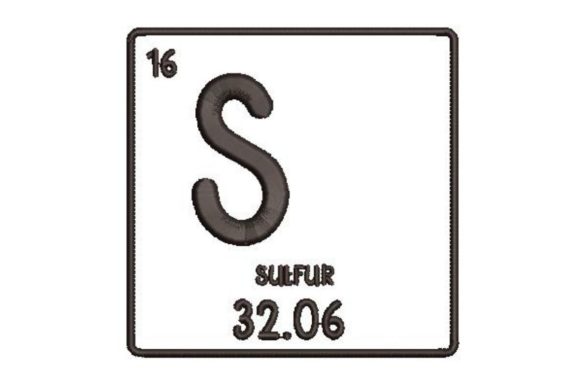
Periodic Table Alphabet Letter S: A Science-Themed Embroidery Design Rooted in Sulfur
The Periodic Table Alphabet Letter S is more than just a stylish embroidery motif—it’s a thoughtful fusion of science education and creative expression. Designed around the chemical element Sulfur (atomic number 16), this letter bridges STEM learning with everyday craft applications. For parents, educators, and hobbyists who value both intellectual curiosity and hands-on creativity, the Periodic Table Alphabet Letter S offers a meaningful way to celebrate scientific literacy—stitched into clothing, classroom displays, lab coats, or personalized gifts.
Many adults seek ways to support children’s growing interest in science without resorting to passive screen time or generic toys. They want tools that spark conversation, reinforce learning, and feel purposeful—not just decorative. At the same time, crafters need designs that are technically reliable: compatible across machines, well-digitized for clean stitching, and versatile enough for different fabric types and project scales. That’s where the Periodic Table Alphabet Letter S stands out—not as a novelty, but as a functional, educational, and production-ready resource.
Why Sulfur—and Why This Design?
Sulfur is one of the most historically significant elements: used since antiquity in medicine and industry, essential to amino acids like cysteine and methionine, and unmistakable for its bright yellow color and distinctive odor. Its inclusion in the Periodic Table Alphabet Letter S grounds the design in real-world relevance—not just symbolism. The letter itself often features subtle scientific details: an atomic symbol (S), electron configuration notation (1s² 2s² 2p⁶ 3s² 3p⁴), or even a stylized sulfur atom diagram—all rendered with precision for embroidery clarity.
This attention to accuracy matters. When kids see “S” paired with authentic chemistry cues—not cartoonish or vague imagery—they begin connecting letters to concepts. It transforms alphabet practice into early elemental literacy. For example, a child wearing a t-shirt with the Periodic Table Alphabet Letter S might ask, “What’s sulfur?”—opening a door to discussions about volcanoes, proteins, or even the smell of rotten eggs (hydrogen sulfide). That spontaneous curiosity is exactly what engaged adults hope to nurture.
Practical Applications Across Real-Life Scenarios
The Periodic Table Alphabet Letter S works across multiple use cases—each solving a distinct need:
- For homeschooling families: Stitch the letter onto study journals, lab notebooks, or science fair banners. Pair it with other periodic table letters (like O for Oxygen or C for Carbon) to build a full alphabet set—turning vocabulary development into a tactile, visual science lesson.
- For teachers and STEM coordinators: Use it on classroom décor, student lab coats, or award ribbons. A wall display spelling “SCIENCE” with periodic-table-themed letters reinforces subject identity while honoring foundational elements—making abstract concepts feel tangible and celebrated.
- For crafters and small-business owners: The design’s inclusion of multiple file formats (PES, DST, EXP, JEF, VP3, XXX) ensures compatibility with Brother, Janome, Bernina, Husqvarna Viking, and other major embroidery machines. Its optimized stitch count and underlay structure reduce thread breaks and stabilizer waste—critical for consistent, professional results at scale.
One practical consideration: always test-stitch on your target fabric first. Lightweight cottons may require tear-away stabilizer; fleece or knit fabrics benefit from cut-away + topping. Because the Periodic Table Alphabet Letter S includes fine details (like subscript numbers or orbital rings), adjusting density or hoop tension slightly can improve legibility—especially for smaller sizes (under 3 inches).
Different Users, Different Approaches
How someone uses the Periodic Table Alphabet Letter S often reflects their goals and context:
- Parents focused on enrichment might pair it with a short, age-appropriate fact card (“Sulfur helps your body make strong hair and nails!”) and sew it onto a backpack—creating a quiet, daily reinforcement of science identity.
- Science camp directors may digitize the letter into a larger appliqué format, combining it with felt or heat-transfer vinyl for durable, wash-resistant patches awarded after chemistry-themed challenges.
- Embroidery professionals appreciate that the design avoids excessive jump stitches and maintains balanced thread coverage—reducing re-hooping and minimizing post-stitch trimming. That efficiency translates directly to faster turnaround and higher client satisfaction.
No single approach is “best”—but all share a common outcome: making science visible, wearable, and personally meaningful.
What Makes This Design Truly Useful—Beyond Aesthetics
Usefulness isn’t just about how it looks—it’s about how easily it integrates into existing workflows and values. The Periodic Table Alphabet Letter S succeeds because it:
- Supports layered learning: It works equally well as a standalone letter or as part of a broader periodic table series—allowing users to scale depth based on interest or curriculum needs.
- Respects technical constraints: Clean edges, appropriate fill angles, and logical stop points (for multi-color versions) mean fewer interruptions during stitching—saving time and reducing frustration.
- Encourages continuity: Unlike trend-driven designs, its foundation in real chemistry ensures longevity. A child who loves the Periodic Table Alphabet Letter S at age 7 may still wear or reference it meaningfully at 12—especially when connected to deeper topics like redox reactions or biochemical pathways.
And because sulfur appears across disciplines—from environmental science (acid rain) to nutrition (vitamin B1) to materials engineering (vulcanized rubber)—the Periodic Table Alphabet Letter S naturally invites cross-subject connections. That versatility makes it a quietly powerful tool for lifelong learners.
Getting Started Thoughtfully
If you’re considering the Periodic Table Alphabet Letter S for your next project, start small: embroider it on a tote bag or pillowcase using medium-weight cotton. Observe how the detail holds up after washing. Then, expand—add coordinating elements (a tiny beaker icon, the atomic mass “32.06”) or combine it with related letters to spell words like “SALT,” “SUN,” or “STAR.”
Most importantly, involve your child or students in the process. Let them choose the thread color (yellow for sulfur’s natural hue? blue for contrast?), discuss why sulfur matters, or sketch their own version before stitching. That co-creation deepens engagement far beyond the finished product.
In a world where science communication often feels distant or overly complex, the Periodic Table Alphabet Letter S offers something refreshingly grounded: clarity, curiosity, and craftsmanship—all stitched together with intention.