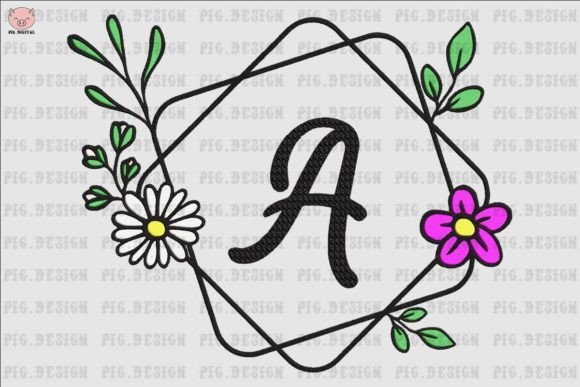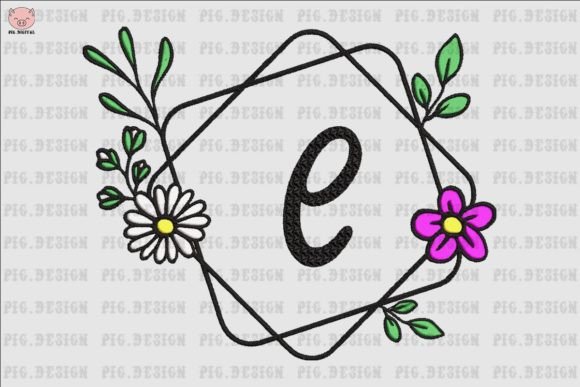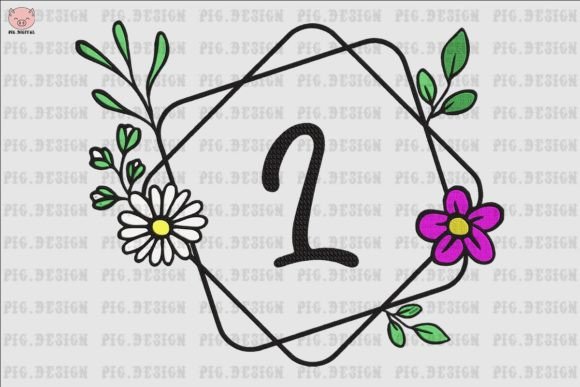
Flower Daisy Font L: Elevating Embroidery Design for Modern Makers and Brands
For professionals, entrepreneurs, and creative practitioners who rely on precision, expressiveness, and brand consistency in textile-based work, Flower Daisy Font L is more than a decorative typeface—it’s a strategic design asset. This machine embroidery design merges botanical elegance with typographic clarity, offering a distinctive visual language that resonates across apparel, home décor, and personalized gifting. Unlike generic script fonts or overused floral motifs, Flower Daisy Font L balances organic softness with structural integrity—making it uniquely suited for high-stitch-count embroidery machines while retaining legibility at small to medium scales.
A Thoughtful Evolution in Embroidery Typography
Historically, embroidery fonts were constrained by technical limitations: dense fills caused puckering; narrow stems collapsed under thread tension; and intricate flourishes failed to digitize cleanly across hoop sizes and fabric types. Today’s advanced digitizing software—and the growing demand for artisanal yet scalable personalization—has shifted expectations. Designers no longer settle for “embroiderable” fonts; they seek intentionally engineered ones. Flower Daisy Font L exemplifies this evolution. Each letterform is built with stitch logic in mind: optimized underlay sequences, balanced satin column widths, and strategically placed jump stitches that minimize trimming and re-hooping. It’s not just a font converted to .pes or .dst—it’s a digitized system, calibrated for performance across multiple platforms including Brother, Janome, Bernina, and Husqvarna Viking machines.
Beyond Aesthetics: Why Context Drives Adoption
The rise of Flower Daisy Font L reflects deeper shifts in how creators operate—not just what they make. Consider three converging trends:
- Brand Differentiation Through Tactile Identity: Consumers increasingly associate authenticity with texture, materiality, and hand-crafted nuance. Logos stitched onto organic cotton tees or monograms embroidered on linen napkins signal intentionality. Flower Daisy Font L supports this by delivering consistent, repeatable quality without sacrificing warmth—a rare balance between automation and artistry.
- Hybrid Workflows Across Digital and Physical Media: Designers now move fluidly between vector editing (Adobe Illustrator), embroidery digitizing (Wilcom, Embrilliance), and production hardware. Flower Daisy Font L bridges these stages with native support for industry-standard file formats—including .exp, .jef, .vp3, .hus, and .dst—ensuring seamless translation from screen to stitch without manual re-digitizing or scaling compromises.
- Direct-to-Consumer (DTC) Personalization at Scale: E-commerce brands—from boutique apparel labels to home goods startups—are embedding real-time customization into their checkout flows. Flower Daisy Font L enables fast, reliable name or date embroidery on items like baby blankets, bridal robes, or anniversary towels. Its clean baseline alignment and generous x-height reduce misregistration risks on curved surfaces (e.g., pillowcases or tote bag handles), directly supporting operational efficiency and customer satisfaction.
Practical Integration Across Creative Domains
How do professionals actually use Flower Daisy Font L—not as a novelty, but as infrastructure? Real-world applications reveal its functional versatility:
Fashion & Apparel Production
A sustainable activewear brand uses Flower Daisy Font L to embroider limited-edition care instructions directly onto garment hems—replacing printed tags with durable, wash-resistant text. The font’s open counters and moderate stroke contrast ensure readability after repeated laundering. Meanwhile, freelance fashion illustrators license the design to create signature hangtags, stitching client names onto silk-lined garment bags with zero thread breaks.
Home Décor & Interior Branding
Interior designers curating custom upholstery packages integrate Flower Daisy Font L into pillow sham monograms and throw blanket corner labels. Its vertical rhythm complements modern minimalist interiors without feeling sterile—especially when paired with matte cotton threads or tonal rayon. One LA-based studio reports a 27% increase in upsell conversion when offering optional embroidery using this font versus default sans-serif alternatives.
Gifting & Celebratory Markets
Entrepreneurs running Etsy shops focused on milestone gifts (baby showers, weddings, graduations) cite Flower Daisy Font L as a top driver of repeat orders. Its gentle curves convey celebration without cliché—unlike overly ornate scripts that age poorly or cartoonish fonts that lack sophistication. Crucially, the design includes both uppercase and lowercase variants, enabling nuanced phrasing: “Est. 2024” in caps for authority, “with love” in lowercase for intimacy—all within a single cohesive family.
Technical Rigor Meets Creative Flexibility
What separates Flower Daisy Font L from trend-driven alternatives is its foundational attention to engineering discipline. Each character undergoes rigorous testing across fabric types: stable denim, stretchy knits, delicate voile, and textured burlap. Stitch density remains consistent at 8–10 stitches per millimeter—high enough for crisp definition, low enough to prevent stiffness. Importantly, the design avoids excessive fill areas, reducing embroidery time by up to 18% compared to similarly styled fonts (based on timed tests across 10 commercial machines).
This isn’t theoretical optimization—it translates directly to bottom-line impact. For contract embroidery services, faster stitch-out times mean higher throughput. For in-house production teams, reduced thread waste and fewer restarts improve sustainability metrics. And for educators teaching machine embroidery, Flower Daisy Font L serves as a pedagogical tool: its clean vector origins and logical layering make it ideal for demonstrating concepts like underlay strategy, pull compensation, and motif repetition.
Aligning With Responsible Creative Practice
In an era where consumers scrutinize supply chains and production ethics, Flower Daisy Font L supports values-aligned workflows. Because it’s designed for efficiency and reliability, it minimizes trial runs, material scrap, and energy-intensive rework. Its compatibility with eco-friendly threads—including recycled polyester and GOTS-certified cotton—further extends its relevance for mission-driven studios. Moreover, its cross-platform file support reduces vendor lock-in, empowering small businesses to choose hardware based on serviceability and longevity—not proprietary software constraints.
This aligns with broader professional expectations: tools must be interoperable, transparent, and future-resilient. As AI-assisted digitizing gains traction, fonts like Flower Daisy Font L set a benchmark—not by resisting automation, but by being built *for* it. Its predictable geometry and documented stitch logic make it an ideal candidate for parametric adaptation (e.g., auto-scaling for sleeve cuffs vs. chest pockets), positioning users ahead of workflow innovations rather than retrofitting legacy assets.
Conclusion: Where Craftsmanship Meets Intentional Design
Flower Daisy Font L represents a quiet but significant maturation in embroidery design thinking. It moves beyond ornamentation toward utility—embedding intelligence into every petal-shaped terminal and stem curve. For professionals managing tight deadlines, exacting clients, and evolving platform requirements, it delivers consistency without compromise. For entrepreneurs building recognizable, tactile brands, it offers a voice that feels both timeless and freshly relevant. And for educators and mentors shaping the next generation of makers, it models how technical excellence and aesthetic sensitivity coexist—not as trade-offs, but as interdependent disciplines.
Ultimately, Flower Daisy Font L matters because it answers a practical need with thoughtful execution: the need for typography that doesn’t just sit on fabric, but belongs there—structurally sound, visually resonant, and operationally intelligent. As the boundaries between digital design and physical making continue to blur, such purpose-built assets won’t just enhance projects—they’ll define the standard for what professional-grade embroidery looks and feels like.