Kids Reading Books with Dog
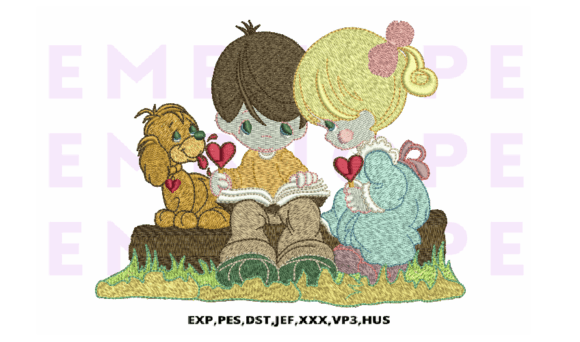
There’s something quietly powerful about the image of a child curled up with a book—and a dog resting nearby. It’s not just a charming scene; it’s a visual shorthand for calm focus, early literacy, companionship, and emotional safety. The Kids Reading Books with Dog embroidery design captures that moment in thread: a child absorbed in a story, a gentle canine companion at their side. More than decorative, it’s a small but meaningful nod to how reading, empathy, and everyday rituals intertwine in childhood development.
Why This Design Resonates Right Now
Families and creators are increasingly seeking ways to personalize children’s spaces and clothing with intention—not just novelty. In an era where screen time competes fiercely for attention, tactile, story-rich imagery like Kids Reading Books with Dog offers quiet contrast. It reflects a broader cultural shift: caregivers, educators, and designers are prioritizing sensory-friendly, emotionally grounded elements in kids’ environments—soft textures, familiar narratives, and visuals that invite connection rather than stimulation.
This isn’t nostalgia dressed up as trend. Research continues to affirm the role of animal companionship in lowering anxiety and supporting language acquisition—especially when paired with shared reading experiences. A child who sees themselves reflected in a design that pairs books and dogs may feel subtly affirmed: “Reading is safe. I belong here. My feelings—and my furry friend—are part of the story.” That resonance translates directly into demand for thoughtful, high-quality embroidery motifs like this one.
From Concept to Cloth: Practical Use Cases
The Kids Reading Books with Dog embroidery design is built for real-world application—not just display. Its clean lines and balanced proportions make it especially effective on children’s apparel: think denim jackets, cotton overalls, backpacks, or soft knit cardigans. Because it’s delivered in multiple machine embroidery file formats—including PES, DST, JEF, and EXP—it integrates smoothly into existing production workflows, whether you’re stitching one-of-a-kind pieces for your Etsy shop or producing small-batch items for a local boutique.
Hobbyists appreciate its adaptability across fabric types—cotton, linen blends, even lightweight twill—while small business owners value its scalability across product categories. A single design can anchor a cohesive collection: matching sibling tees, library-themed tote bags, or custom storytime aprons for preschool teachers. Importantly, it avoids overly complex details that struggle on knit fabrics or shrink unpredictably, making it reliable for consistent results.
What You Need to Know Before Stitching
Like all precision embroidery designs, Kids Reading Books with Dog performs best when used as intended. The note about resizing and alterations isn’t a limitation—it’s a quality safeguard. Embroidery relies on stitch density, underlay logic, and thread tension calibrated for specific dimensions. Shrinking the design too far risks losing fine detail (like the curve of a dog’s ear or the spine of a book); enlarging it excessively can cause puckering or thread breakage, especially on lightweight fabrics.
That said, minor adjustments—within 10–15% of the original size—are often viable with proper stabilizer selection and test stitching. For example, using a tear-away stabilizer on woven cotton or a cut-away for knits helps maintain shape. If you're planning a line of toddler onesies, start with the smallest recommended size and run a sample on scrap fabric first. Professionals working with contract embroiderers should share the native file format compatible with their machine brand—no conversion needed.
Design Integrity Matters—Especially for Kids’ Products
When stitching for children, durability and safety are non-negotiable. This design’s balanced fill-stitch coverage and smooth satin borders minimize snagging risk—a practical advantage over highly textured or densely layered motifs. Its moderate stitch count also reduces wear on home embroidery machines during repeated use, supporting long-term reliability for makers who produce regularly.
Equally important is visual clarity. Unlike abstract or stylized motifs, Kids Reading Books with Dog uses instantly legible iconography: a recognizable book shape, a friendly, non-intimidating dog posture, and a child seated comfortably—not posed or exaggerated. That clarity supports inclusivity: it reads across age groups, abilities, and cultural contexts without requiring explanation.
Beyond Clothing: Where This Motif Fits Into Broader Creative Practice
Creative professionals—from textile designers to early childhood curriculum developers—are noticing how narrative-driven embroidery supports deeper engagement. A preschool teacher might stitch this motif onto a felt story board, pairing it with laminated book and dog cutouts for interactive literacy stations. A freelance surface pattern designer could deconstruct its elements—dog silhouette, open book outline, child’s profile—to build a larger repeat pattern for organic cotton crib sheets or classroom curtains.
For entrepreneurs launching subscription boxes for emerging readers, this design adds tangible warmth to packaging inserts or branded cloth book sleeves. It bridges function and feeling: yes, it decorates—but more importantly, it signals values. When parents see it on a product, they read care, intentionality, and developmental awareness—not just aesthetics.
Trends That Support, Not Dictate, This Choice
You won’t find Kids Reading Books with Dog trending on TikTok feeds—but that’s by design. It aligns with quieter, more enduring shifts: the rise of slow parenting, renewed interest in tactile learning tools, and growing consumer preference for products with clear purpose and ethical production. It doesn’t chase viral novelty; instead, it supports habits that last—daily reading routines, intergenerational storytelling, and mindful play.
Similarly, the move toward hybrid creative workflows makes multi-format embroidery files essential. Whether you’re designing in Wilcom, converting files in Embrilliance, or sending directly to a Brother or Janome machine, compatibility removes friction. That flexibility matters most for time-constrained professionals—freelancers juggling client deadlines, educators preparing classroom materials during summer breaks, or small-batch makers fulfilling holiday orders without outsourcing digitizing.
A Note on Realistic Expectations
No embroidery design replaces the lived experience of sharing stories with a child—or the comfort a dog provides during moments of uncertainty. What Kids Reading Books with Dog does offer is a small, repeatable gesture of affirmation. It’s a reminder stitched into fabric: reading is joyful. Learning is relational. Quiet moments matter.
Its strength lies in consistency—not flash. It works because it doesn’t try to do everything. It doesn’t mimic photorealism, nor does it sacrifice readability for artistic abstraction. It occupies a practical middle ground: distinctive enough to stand out, simple enough to reproduce reliably, and warm enough to invite repeated use.
Getting Started Thoughtfully
If you’re new to machine embroidery, begin with a single project: a child’s favorite jacket or a reusable lunch bag. Choose medium-weight cotton and a standard needle (size 75/11). Hoop the fabric with light- to medium-weight tear-away stabilizer—enough support to prevent shifting, not so much that it stiffens the final piece. Run the design at recommended speed (usually 600–800 stitches per minute), and inspect the back for loose threads before trimming.
For seasoned users, consider layering this motif with complementary text—like a child’s name in a clean sans-serif font—or pairing it with coordinating appliqué elements (a tiny bone shape, a stitched bookmark curl). Just remember: cohesion comes from restraint. One well-placed Kids Reading Books with Dog speaks louder than three crowded motifs.
Ultimately, this design endures not because it’s trendy—but because it meets real needs with quiet precision. It supports literacy without lecturing. Celebrates companionship without sentimentality. And gives creators a trustworthy tool to make meaning, one stitch at a time.