Jungle Theme Kids Schedule Planner
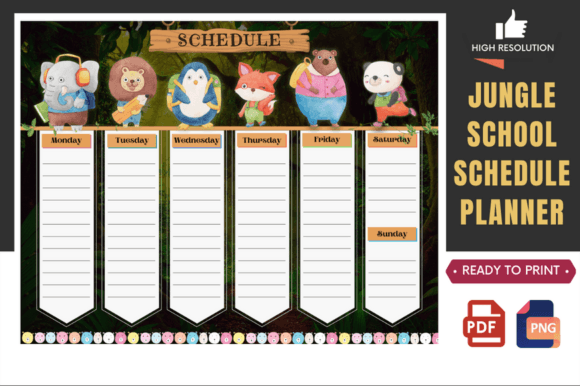
The Jungle Theme Kids Schedule Planner is a printable weekly activity planner designed for children, featuring jungle-inspired illustrations—think playful monkeys, cheerful parrots, and leafy vines—to support routine-building in a visually engaging way. It includes one high-resolution digital file set: a 22-inch by 17-inch Weekly Jungle School Schedule Banner, delivered as both a PDF and a PNG. Both files are sized at 6336 × 4896 pixels and rendered at 300 DPI, allowing crisp printing at large scale. The banner is organized into day-based columns, giving space to record morning, afternoon, and evening activities—including school tasks, homework, playtime, meals, and rest.
Families often seek tools that help children understand time, anticipate transitions, and develop independence. A visual schedule can support those goals—especially for kids who respond well to images, color, and structure. The Jungle Theme Kids Schedule Planner meets this need with a cohesive, child-friendly aesthetic that avoids visual clutter while maintaining clarity. Its large format encourages wall mounting in a study area or bedroom, making daily expectations visible and accessible without requiring constant adult prompting.
One benefit is flexibility: because it’s a digital download, families can print it multiple times, adjust display locations, or reprint after erasing or updating entries. The high resolution ensures legibility even when enlarged beyond the standard 22″ × 17″ size—useful for classrooms or shared learning spaces. The inclusion of both PDF and PNG formats accommodates different printing workflows: PDF preserves vector-like text sharpness and is ideal for home or office printers; PNG offers transparency options and works well with large-format print services.
However, there are practical tradeoffs to consider. As a static, non-editable file, the planner does not support digital interaction—no typing, saving, or auto-updating. Families preferring tablet-based routines or apps with reminders and progress tracking may find this limiting. Similarly, children with specific learning needs—such as those requiring customizable symbols, adjustable font sizes, or AAC-compatible visuals—may need supplemental adaptations, since the design follows a fixed layout and illustration style.
Another consideration is implementation effort. While the planner itself is ready to print, consistent use depends on adult support during setup and review. Introducing the schedule meaningfully—discussing each activity, modeling how to update it, and linking it to natural cues (e.g., “After breakfast, we check the monkey column”)—increases its effectiveness. Without that scaffolding, even an attractive tool may sit unused or become a source of frustration.
This planner is a strong fit for households where caregivers value tactile, screen-free organization and have access to a reliable printer capable of handling larger paper sizes. It suits children aged 4–10, particularly those beginning formal schooling or adjusting to new routines like back-to-school transitions. Homeschooling families, therapists supporting executive function development, and early elementary educators using visual schedules in small-group settings may also find it practical—especially when paired with consistent language and reinforcement strategies.
It may be less suitable for families without easy access to large-format printing, or those prioritizing portability—since the physical banner isn’t easily carried between home and school. Likewise, children who thrive with highly personalized or frequently changing structures may outgrow the fixed column layout quickly. In such cases, alternatives worth exploring include dry-erase weekly boards with interchangeable cards, app-based planners with voice prompts and timers (like Choiceworks or Time Timer), or customizable Canva templates that allow editing before printing.
When evaluating whether the Jungle Theme Kids Schedule Planner aligns with your needs, reflect on three questions: First, what role does visual structure already play in your child’s daily routine? If they respond well to picture-based cues or benefit from seeing the sequence of their day, this planner supports that strength. Second, how much time and consistency can you invest in introducing and maintaining the tool? A schedule only works when it’s reviewed regularly—not just posted. Third, what’s your preferred balance of analog and digital tools? If minimizing screen time is a priority, and you’re comfortable managing printed materials, this planner fits naturally into that approach.
Also consider scalability. Because the file resolution supports enlargement, it’s viable for shared spaces like learning nooks or therapy rooms—but only if you have access to appropriate printing resources. If you plan to laminate and reuse it, verify that your printer output meets lamination requirements (e.g., ink doesn’t smudge). And while the jungle theme is broadly appealing, assess whether your child connects with the imagery: some children engage more deeply with themes tied to personal interests—dinosaurs, space, vehicles—or neutral designs that avoid thematic overload.
Finally, recognize that no single tool guarantees routine adherence. The Jungle Theme Kids Schedule Planner is one component of a broader support system. Its value emerges alongside predictable transitions, co-created expectations, and responsive feedback—not in isolation. Used thoughtfully, it can reinforce autonomy and reduce daily friction. Used passively—as decoration or a one-time setup—it’s unlikely to yield meaningful change.
In summary, the Jungle Theme Kids Schedule Planner offers a well-designed, printable option for families seeking a screen-free, visually supportive weekly schedule. Its strengths lie in clarity, print quality, and thematic appeal. Its limitations center on static functionality and reliance on consistent adult facilitation. Whether it’s the right choice depends less on its features alone and more on how those features intersect with your child’s learning profile, your household’s logistics, and your long-term goals for fostering independence and predictability.