Hello Fourth Grade SVG: A Layered Digital Cut File for Educators and Crafters
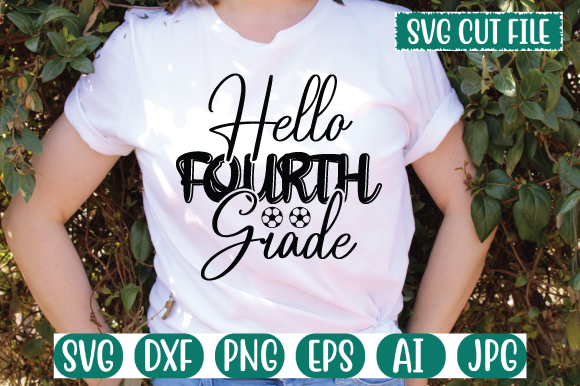
The Hello Fourth Grade SVG is a purpose-built, layered digital cut file designed specifically for educators, homeschooling parents, crafters, and small-business owners creating back-to-school projects. Unlike generic school-themed graphics, this design centers on the milestone of fourth grade—offering age-appropriate visual language, clean typography, and intentional layering to support precise cutting across multiple platforms. It’s not just decorative; it’s engineered for function, flexibility, and classroom relevance.
What You Actually Get in This Design File
This is a DIGITAL DOWNLOAD ONLY package—no physical items, no shipping delays. Inside the single ZIP file, you’ll find six distinct, production-ready file formats, each serving a specific role in your workflow:
- 1 SVG File (Layered): Fully separated layers with labeled elements (e.g., “text,” “border,” “decoration”), enabling selective cutting, color assignment, or editing in Cricut Design Space, Silhouette Studio, or Inkscape.
- 1 EPS File: A high-fidelity vector format compatible with professional print services and legacy design software—ideal when scalability and crisp line work matter most.
- 1 PNG File (Print-Ready): Transparent background, 300 DPI resolution—suitable for overlays, digital newsletters, classroom signage, or sublimation mockups where vector editing isn’t needed.
- 1 DXF File: An AutoCAD-compatible vector format that retains geometry without styling—useful for laser engraving, CNC routing, or integration into engineering or architecture workflows.
- 1 AI File: The native Adobe Illustrator source file, preserving layers, paths, fonts (converted to outlines), and editable swatches—best for users who need to adjust spacing, scale individual components, or rebrand the design.
- 1 JPEG File: High-resolution, RGB-formatted preview image—practical for quick reference, social media posts, or client proofs where transparency or vector fidelity isn’t required.
Together, these files provide redundancy and adaptability—not overkill, but coverage. If you’re using Cricut, the SVG handles most tasks; if you're preparing vinyl decals for a school PTA booth, the EPS or AI ensures consistent output across vendors; if you're designing t-shirts for a fourth-grade field trip, the PNG gives you immediate drag-and-drop usability in Canva or Photoshop.
How Hello Fourth Grade SVG Fits Within Broader Back-to-School Resources
Many buyers encounter Hello Fourth Grade SVG while browsing broader bundles—like “Back to School SVG Bundles” or “Teacher SVG Collections.” Those bundles often prioritize volume: dozens of designs covering kindergarten through graduation, monograms, chemistry icons, school buses, and book motifs. They’re useful for variety—but less so when you need precision for one grade level.
In contrast, Hello Fourth Grade SVG offers focused utility. It avoids visual clutter common in multi-grade packs—no mismatched fonts, inconsistent line weights, or irrelevant symbols. The composition reflects developmental appropriateness: slightly more detailed than first-grade graphics, yet still legible at small sizes (e.g., on pencil pouches or name tags). It doesn’t try to be everything—it aims to be reliable for its intended use case.
Compare that with standalone “First Day of School” or “School Diva” SVGs. Those often emphasize personality or humor—great for parent-led shirt projects, but less suited for official classroom materials. Hello Fourth Grade SVG leans toward clarity and inclusivity: neutral color suggestions, balanced negative space, and scalable proportions that work equally well on bulletin boards, laminated badges, or digital learning slides.
Compatibility: Where It Works—and Where You Might Need More
The file set is explicitly built for cross-platform compatibility. It works with:
- Cricut machines (Explore, Maker, Joy) via Design Space
- Silhouette Cameo and Portrait models using Studio
- Inkscape (free, open-source vector editor)
- Adobe Photoshop (for raster-based edits using the PNG/JPEG)
- Adobe Illustrator (full editability via AI/EPS/SVG)
That breadth matters—but it’s not universal. If you rely exclusively on CorelDRAW or Affinity Designer, the EPS may require conversion steps, and the DXF won’t carry color or stroke data. Similarly, while the PNG is print-ready, it’s not CMYK-optimized—so commercial printers may request the EPS or AI for full-color offset runs. These aren’t flaws; they’re format boundaries. Knowing them helps avoid last-minute roadblocks.
Realistic Use Cases: When This File Shines
Hello Fourth Grade SVG excels in scenarios where consistency, grade-level relevance, and technical readiness intersect:
- Classroom door decorations: Layer the SVG to cut vinyl letters separately from a border element—then apply each piece with alignment guides.
- Student name tags or desk plates: Resize the PNG or SVG to fit standard label dimensions without pixelation or distortion.
- Teacher resource packets: Embed the transparent PNG into PDF handouts or Google Slides without background interference.
- Small-batch apparel: Use the AI file to adjust kerning before sending to a DTG printer—ensuring “Fourth Grade” reads clearly even at 8 inches wide.
- Homeschool recordkeeping: Import the DXF into a laser cutter to create wooden milestone markers for portfolio displays.
It’s less ideal for highly stylized applications—think watercolor textures, hand-drawn imperfections, or animated web graphics—since all included files are clean, vector-based, and flat. If your project demands organic texture or motion, you’d supplement this file with additional assets, not replace it.
Decision Factors: Is This the Right Choice for You?
Consider Hello Fourth Grade SVG if:
- You’re preparing materials specifically for fourth-grade students—not a general “school” audience.
- You value having multiple editable formats rather than betting on a single file type.
- You cut across devices (Cricut + Silhouette) or collaborate with others using different software.
- You prefer minimal post-download editing—everything is pre-outlined, grouped logically, and tested for clean cuts.
Look elsewhere if:
- You need editable text (e.g., to swap “Fourth” for “Fifth”)—fonts are converted to outlines, so changes require redrawing or manual path adjustment.
- You’re building a long-term brand identity and need custom illustration, icon sets, or matching color palettes beyond this single motif.
- Your workflow depends heavily on cloud-based tools without local file import (e.g., certain versions of Canva Pro that restrict SVG uploads).
There’s no universal “best” SVG file—only what aligns with your tools, timeline, skill level, and end goal. Hello Fourth Grade SVG meets a narrow but meaningful need: delivering technically sound, grade-specific, production-ready assets without requiring design expertise to deploy.
Final Perspective: Utility Over Volume
In a landscape saturated with bundled SVGs promising “100+ designs,” the value of Hello Fourth Grade SVG lies in its restraint. It doesn’t distract with unrelated themes or redundant variations. Instead, it provides what’s necessary—six interoperable files, thoughtfully structured, with clear documentation implied by its organization. For educators juggling lesson plans and supply orders, or crafters fulfilling custom orders on tight deadlines, that kind of focused readiness saves time, reduces trial-and-error, and supports consistent results—whether you’re cutting vinyl for a classroom wall or prepping files for a local print shop.